A NEW INTERPRETATION OF REGGIO’S ‘KOYAANISQATSI’
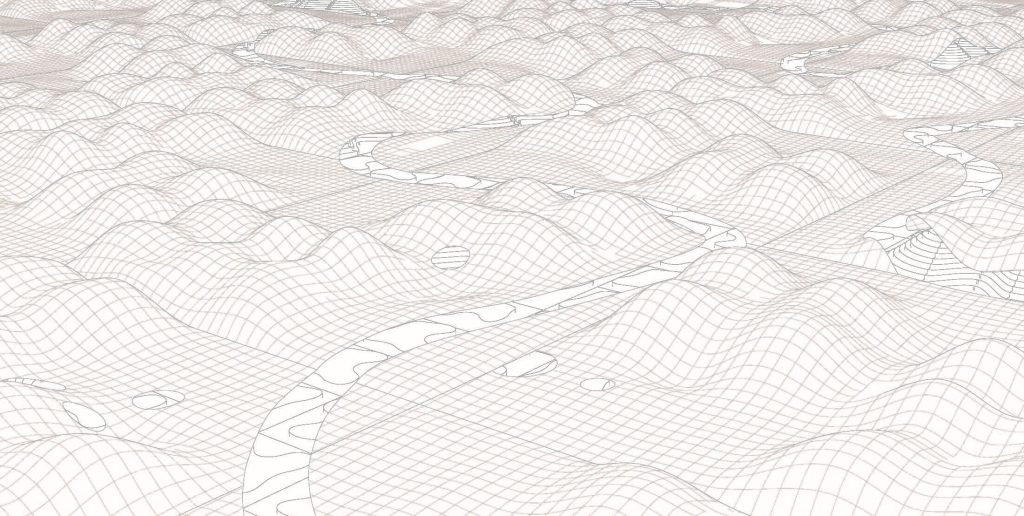
This magazine defines ‘invasive’ as a systematized and highly competitive overwriting of existing environments, irrespective or perhaps with disrespect to that which was already there. In this case, however, is not every system ‘invasive’? A system or a typology is merely a set of rules, a standard method of organization rather than the proposal of a unique solution. Even in the case that an architect intensely studies, understands, and constructs with utmost care to that which exists on site, is not the way in which they design, and the tools they use to do so a system? If no solution is unique, is all human intervention ‘invasive’? How is our own construction, if invasive, any less destructive to the existing environment than its so called ‘natural’ counterparts?
With the hope of addressing these questions, I refer to the documentary ‘Koyaanisquatsi’ and the discourse surrounding it. ‘Koyaanisqatsi’, meaning ‘life out of balance’ in Hopi (a Uto-Aztecan language of the Hopi people native to northeastern Arizona)1, is a one and a half hour, non-narrative film directed by Godfrey Reggio and released in 1982, that captures and presents its viewers with both sweeping and close-up frames of the
urban and natural environment.
Structured almost as a stream of consciousness, for the first thirty minutes we are met with slow moving
footage of vast expanses of untouched wilderness: aweinspiring vistas of the rock formations of the American
West, countless waves breaking majestically on the open ocean, and cumulus nimbus clouds sped up to resemble chariots rolling unwaveringly across blue skies. There is an emphasis here on texture, not in the
sense of materiality, but rather a call to the patterns that emerge in nature on a larger scale, and the tenacity of
these grand forms. Quickly, however, Reggio thrusts us into the urban and industrial landscape, and we are buried under an avalanche of concrete, steel, and smog.
Often, Koyaanisqatsi is interpreted as a polemic on human industry and its environmental impact; though, without a narrator or strict plot, this is not the only lens attributable to his work, and I’d argue, not the most compelling. To illustrate, in reviews, many take the stance that Reggio is an ecological activist who intends for Koyaanisqatsi to rouse fury and vehemence against the sprawl of the metropolis in his audience. In the article ‘Quatsi Means Life’ published under UC Berkeley’s Film Quarterly, reviewer Micheal Dempsey writes “Koyaanisquatsi turned out to be a feature-length montage juxtaposing the pristine beauty of unspoiled nature with the more ambiguous ‘terrible’ beauty of humanity and its creations”2. The film also faces accusations of hypocrisy. For example, Kevin Thomas of the Los Angeles Times claims, “the film is inescapably caught on the horns of paradox: it may be a work of art,
but it’s also the product of an extremely sophisticated technology placed in the service of protesting that same technology, therefore it is self-limiting.”3
However, it seems misguided to argue that Reggio, or anyone with enough intrepidity to reject an upbringing as a monk of the Roman Catholic order, more specifically, the Christian Brothers, who in his own words “were basically Calvinists and believed that the body was evil,”4would take the bold step of leaving the monastery only to preach its own primitivist message. In other words, I see Koyaanisqatsi as a depiction of transformation rather than “juxtaposition”. Rather than flipping between scenes of the ‘natural’ and scenes of the ‘built’ to shock and disgust his viewers, Reggio gradually builds from the awe-inspiring ‘natural landscape’ to its human equivalent, or ‘urban landscape’. Therefore, redefining our preconceived notion of ‘the natural’.
This becomes very clear through Reggio’s manipulation of scale. Moving interchangeably between images of humans both magnified to reveal the wrinkles on an individual’s face to grandiose panoramas of entire cityscapes – sometimes all in the same shot – Reggio posits that when examining human behavior on a larger scale, like a snowflake in a glacier, we form a system that contributes to our own new geological force (equaling erosion, plate tectonics, and volcanism). For instance, at the timestamp 01:26:10, cinematographer Ron Fricke places the camera at the street level and slowly raises it to a vantage point high above the city at a bird’s eye view. If the viewer isn’t paying attention, they might not notice that after a few seconds the clip of the cityscape from above is replaced by that of an enlarged microchip: a visual metaphor describing the ‘natural’ pattern system that occurs at all scales of human infrastructure.
To better understand Reggio’s proposal of urban development as a geological force, it is helpful to consider Cristina Parreno Alonso’s argument that in relation to deep-time, human intervention on the landscape in the 20th century constitutes a major rift in the geomorphic cycle. Professor Alonso, from the Massachusetts Institute of Technology’s School of Architecture, writes “just as the natural geomorphic cycle is a balance of erosion, flows of Earth’s matter, and landform building, so the ‘built’ entails cyclic processes of excavation, extraction, transportation, construction, […],” and thus, “architecture has become a geological force whose consequences need to be viewed from the vantage point of the planet, from geological timescales of observation.5
Perhaps neither Reggio nor Alonso consider human development, whether that be urban or industrial, to be particularly beautiful. However, they both acknowledge it as a natural geomorphic system – where the term ‘natural’ refers to that which already exists, and that which exists having already been ‘built’ – a contrast to the stereotypical ecologist’s lens that human infrastructure and development plagues the natural environment.
Reggio contends that whether we like it or not, we are the ‘natural’, and as such hold the responsibility to design and manufacture the environments that we inhabit. Rather than a futile call to halt industrial activity, this perspective embraces technological advancement. To borrow the words of Slavoj Zizek – an unlikely but oddly appropriate source – “as Marx defines religion, ecology has become the opium of the masses.”6
- Malokti, Ekkehart. Hopi Tales of Destruction. Bison Books, 1 Dec. 2002. ↩︎
- Dempsey, Michael. “Quatsi Means Life: The Films of Godfrey Reggio.” ; Berkeley, 1989, p. 2, www.proquest.com/docview/223106194/fulltextPDF?accountid=14214&pq-origsite=primo&searchKeywords=Koyaanisquatsi&sourcetype=Scholarly%20Journals.
↩︎ - Thomas, Kevin. “MOVIE REVIEW: A HOPI VISION of LIFE as METROMANIA.” Los Angeles Times, vol. 1-i10, no. (1923-1995), 17 June 1983. ProQuest, www.proquest.com/docview/153499747?pq-origsite=primo&accountid=14214&searchKeywords=Koyaanisquatsi&sourcetype=Newspapers. Accessed 5 Oct. 2025.
↩︎ - Godfrey, Reggio. Koyaanisqatsi. 1982, tubitv.com/movies/302693/koyaanisqatsi. Accessed 5 Oct. 2025.
↩︎ - Parreño Alonso, Cristina. “Deep-Time Architecture: Building as Material-Event.” Journal of Architectural Education, vol. 75:1, no. 142-144, 10 Mar. 2021.
↩︎ - Zizek, Slavoj. “Slavoj Zizek – Censorship Today: Violence, or Ecology, a New Opium for the Masses I.” Www.lacan.com, 2007, www.lacan.com/zizecology1.htm. ↩︎
