Profane Night
Night has been a perpetual trouble to human settlement, with night representing at first danger from animals, and then later from people, where it anonymized and provided cover. Humans learn to both fear and appreciate darkness–innovating solutions to its perpetual fall. We began with wood and oil flames, then, skipping forward a few hundred thousand years, gas lighting and eventually electric lighting followed. What we take for granted–or rather accept as normal–is a recent innovation in the mindset of the same industrialized ecosystem. We no longer rise with the day and sleep with the night in the modern. When the night was first lit by gas streetlamps, then moonlight towers, and electric lights, humans were finally able to venture into the night safely. Yet it soon took on an additional role. The city thrived in the shadows of the lamplight, in places such as Hyde Park, where intentionally unlit areas served as a sexual meeting place for an otherwise rigorous social society. Humans’ first terror became a system of value and class. In the present, the synthetic light guides us away from the terrors and immoralities of darkness. Thousands of lights output lumens we will never see or use because mankind’s first terror, and then delight, is the dark.
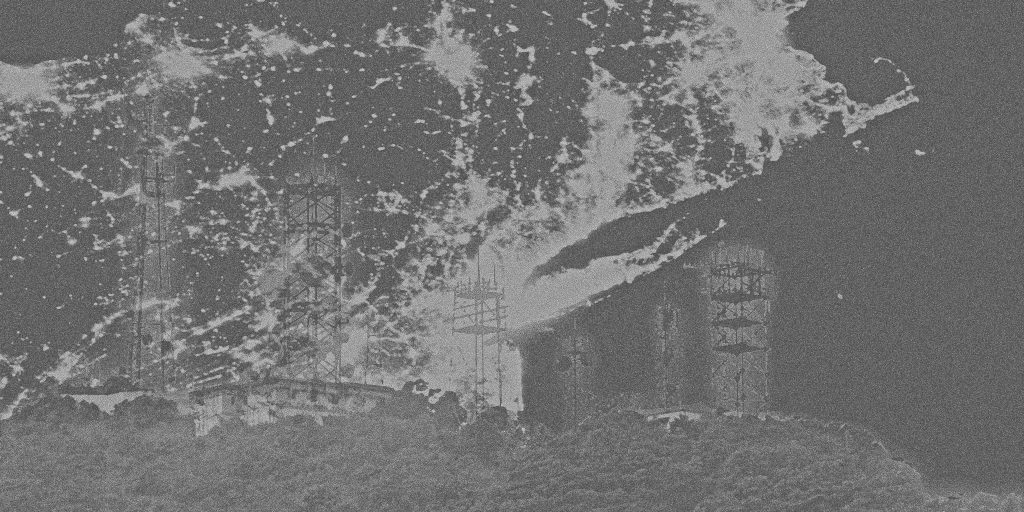
Beyond the individual, the infrastructural system of light reveals a diagrammatic language of the night. Patterns emerge through satellite and aerial analysis, and the social arteries of the day become apparent in the night. The highways’ arteries are illuminated by hundreds of headlights proceeding into smaller veins and nodes such as shopping malls, baseball fields, and homes–creating the nervous system of the night and illuminating the perceived safety and value of urban objects. Skyscrapers glow lightly like paper lanterns, car lots like white boxes. A vault of light in a grid of darkness, ports and transport hubs with their utilitarian side lights, and houses dotted with small security lights. Houses in curvilinear form, in gridded dots, the dominating node of urban nights. The modern map of the night doesn’t value the freedom of darkness but instead security and control. Earth has become a glowing beacon, in and of itself transformed by our temporary illumination of the ether. Street lamps, security lights, and headlights all serve as elements of safety and order in a darkness that dissolves all other systems of order.
Sacred Altars
We build cathedrals to connectivity and our new global economy, displacing our churches of the past. This is not a new revelation. We now dedicate our highest peaks and rooftops to altars of connectivity and our paths to veins of screaming light. Where once Pagodas stood, fenced altars to utility now prevail. Transportation networks occupy the most important sites in our cities, weaving in between fortresses and strongholds of economy. Capital secularizes the sacred realm and resanctifies it as a religion of nodes.
Humanity worshipped the light, placing it on the highest pedestal of value. With the advent of the moonlight tower, America placed light atop a monumental altar, interpreting the sun in physical form as a tectonic altar to guidance and safety, and putting it above the realm of the banal. The moonlight tower is part of the human compulsion to place our most valuable objects atop mountains and towers closer to the sky to show their value, demarcating a holy site of progress. Now, in the modern century, we place cellular towers, and mechanicals, lighting, and helipads, our most noble aspects of connectivity and guidance, atop our highest peaks, which we connect intangibly in our digital networks. What once were cathedrals and temples stretching to the gods, networks of spires and stairs, are now testaments to man’s hubris atop the world projected through communications equipment. The lighthouse, guiding ships into harbor, has turned into the cellular tower, a guiding wave sending information.
In building upon a culture of new monuments to a 21st-century of systems, not enough attention has been paid to the evolving culture of altars. The hidden artificial systems of light that thread into all scales of human context have become unlikely objects of devotion, monuments to an addiction of the 21st century. The great modernists painted with natural light, not with the profanity of darkness, and the plight of man’s illuminations. Today’s cell towers are not considered part of the lineage of the great temples of the past. Yet we must acknowledge the new forms these old systems have taken and consider their analysis within the context of their related pasts. We continue to build altars that separate us. In an age with everything at our fingertips, the communications tower can be viewed as both a malevolent and positive force–a temperamental god. Similarly, man-made light allows darkness to be villainized in a world of rightful concern for safety. Yet, we hardly consider the spatial aspects of light as architects do with natural light. We reflect our darkest fears and our most sacred objects in the night, allowing the nonessential to fade away into the profane realm.
