A SISYPHIUS WITH A SOLAR ANUS, UNDER A NEO-LIBERALIST STRUCTURE
ABSTRACT
The minds of architectural scholars and workers have always been systematically invaded-in subject to a structural pressure that functions through what Foucault would call Disciplinary Power, as Marx would say the Ideological Force of the Superstructure. It is no longer a productive society, but an achievement society. Under a thriving ideology of neo-liberist self exploitation.
In an economy where intelligence and efficiency are moralized and virtualized, the value of labor in the architectural industry has been degraded, yet the structure remains impervious to individual intervention.
Data in income only confirms this structural saturation: In 2021—one year before the introduction of ChatGPT on November 30, 2022—U.S. architects earned a median of $80,180 versus $51,480 for all full-time workers (BLS 2021). By 2025, three years into widespread AI adoption, architect wages rose only to $82,840, while the national median reached $62,088 (USA Wage 2025).
This dissociation of growth in income indicates that architectural labour, being one of the professions most entwined with AI-facilitation did not experience
a corresponding lift in income. For a 3.3% growth in three years versus a 20.6% boost in the median income of all occupations.
Marx’s formulation becomes eerily prophetic: “The more the worker produces, the less he has to consume.” (Marx 1959, 30). Frankly, a decline in income and social status accompanied by an exponential increase seems unreal in a Lockean liberal utopia. Workers are eroding, while there was never “enough and as good left in the common for others” (Locke, 1980, 275). But in this crisis nowadays, it is no longer a problem of the workers being alienated from the objectification of their labor-they get to keep their models, writings and drawings and sign their names on it, but the products themselves are getting worthless.
As the resolution of the solutions that AI offers gets higher, the architectural labour of humans would be doubly devalued. It will face a collapse of labor’s scarcity. But the architectural workers and scholars are remaining productive. They are fatally trapped in a cycle of self-driven exhaustion:
producing more for the preservation of a diminishing value
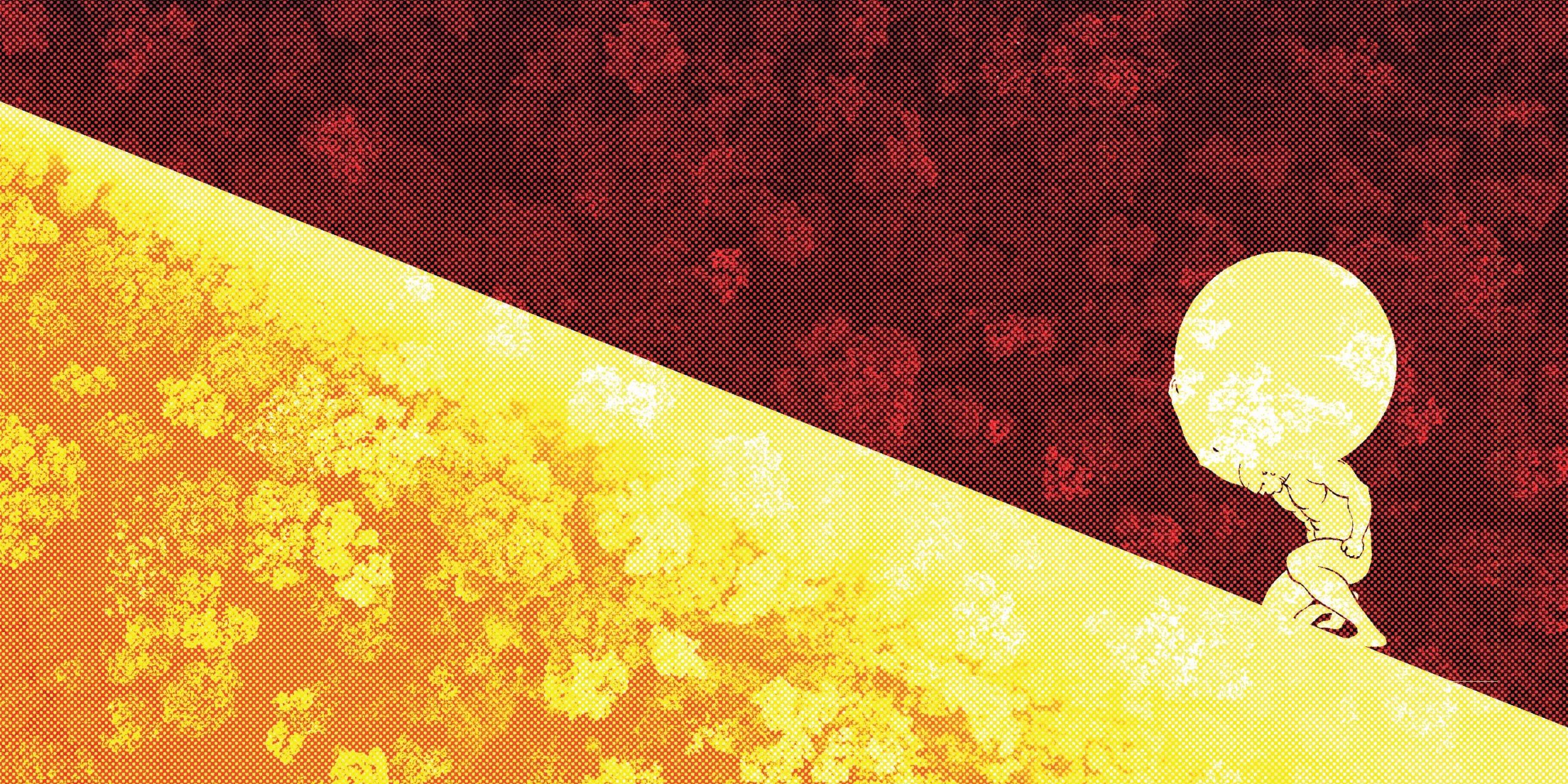
In response to that crisis, an Architectural Being must be defined. It is a student, worker or a scholar in the architectural industry. In notion to Marx’s species-being who does not produce merely to survive but for self actualization. For those who not only produce intellectually and freely, but also have a clear sense of the value of their production in a neo-liberal free market. To differ from Marx’s unachievable idealisms, the architectural-being would do anything to succeed and amplify their ideology. They are Modern Sisyphuses—ensalved kings who are pushing two boulders instead of one. One for adaptation of self, and another for preservation and amplification of their architectural ideologies.
THE ARCHITECTURAL BEING
For an architectural being, their will of producing an architectural manifesto is so strong and overwhelming, that their work is not just an objectification of their labour, but an externalization of their beliefs, fears, and desires. This desire does not just arise from consumerism, but from arts and science itself. This drive does not emerge solely from consumerist pressures; it comes from the deeper engines of art and science themselves. The manifesto becomes the self. In this process, amour-propre—Rousseau’s notion of an unhealthy, socially dependent self-love arises. The architectural beings define themselves not only by what they create, but by how others see, judge, and validate that creation. Their motivations are therefore not the virtuous, civic-minded impulses Rousseau glazed in the Spartans, but the anxious, competitive energies of visibility, reputation, and recognition. For it is not as virtuous as how Rousseau compares artists to the Spartans, but it gives architectural beings the most incentives to thrive and make a stance in a declining industry.
The spatial concepts and building technological agencies of architecture itself can no plonger feed the growing needs of the market, more radical entrepreneurs arise. Like how Deleuze and Guattari illustrate the dynamics of desire in a modern context as a machine driving other machines. Products of Architectural-beings are passionate products made by passionate schizophrenics.
ARCHITECTURAL BEINGS SHOULD HAVE A SOLAR ANUS
Deleuze describes self-motivated theory entrepreneurs like Judge Schreber as someone who has “sunbeams in his ass” (Delezue 1983, 32). The ones who acquire a solar anus should be a reproductive machine that can feel the desires, translate the desires into production, and is capable of explaining the process theoretically. It is the effect of a pure machine, not mere metaphors that are vague and in its own mere logic, numb and immune to critique.
A STRUCTURAL TRANSITION: THE PAST AND THE FUTURE
It is no longer a time of Walter Gropius and the post-war reconstruction. It is an innovative post-human, post-science era, in which figures like Richard Rogers, Patrik Schumacher and Rem Koolhaas that are iconizing themselves and being the closest to a capitalism achievement approach. The architectural-being with a solar anus is meant to be exhausted, for creativity itself, distanced from a Bauhausian educational system, is self-exploitation. Like how Byung-Chul Han
would describe in his famous “Burnout Society”, the entrepreneur’s freedom is paradoxical, the aggressive pursuit of limitless achievement leads directly to self-exhaustion and a state of being “too alive to die, and too dead to live.” (Han 2015, 14) which is the undead.
This exhaustion is not just a pathetic approach for entrepreneurship, architectural-beings are not only required to have this level of self-exploitation when they reach a starchitect’s level. It is now the average expectation of a professor and a client. The professor wants the students to shape their own passionate, designated research while the clients need tremendous help in theory and practice to shape their own identity. The Exhaust society is now the neo-liberal market. If one stays to be the undead rather than the architectural-being, their 5-years bachelor education would be a pure waste.
But the change is nothing new. Compared to a digital revolution in workflow that was brought by computer-aid design software, this is only a Second Digital Turn. Deleuze’s view of our pre-mechanical paster doubles as an eerily cogent anticipation of our digital future. With the sorting of information almost replaced by artificial intelligence, a market need and expectations shifted. As how would Micheal Speaks state intelligence in design is the new intellectual dominant of the 21th century, a post-vanguard era whereas thought is no longer only led by a Deleuzian constructivism nor a Derridean deconstructivism. “Intelligence-based practices are instead entrepreneurial in seeking opportunities for innovation that cannot be predicted by any idea.” (Speaks 2007, 03). This shift does not reduce any burden, it multiplies it. Architectural-beings must learn how to use automation to remove tasks in order to leave room for the new demands: the constant evaluation and experimentation of algorithmic processes. “Simulation and search can solve problems that the formalistic approach of modern science could never tackle. Computers can search faster than humans can sort.”(Carpo
2017, 48). It is no longer collecting form and recreating it, it’s about adapting the new form of data consumption, transitioning the method of research, and then learning how to build unimaginable complexities on a Second Digital turn.
CONCLUSION
It is not a discussion of whether the workers are being alienated nor the society
is exhausted. The workers will be forever alienated and the architectural working-class would forever be exhausted. The only legit proposal is to economize this inevitable self-exploitation. As individuals are all underwater in this digital transition, they must do design intelligently instead of doing mechanical problem solving, to be the Architectural-being, a passionate Sisyphus with a solar anus that pushes two boulders—a strict requirement of adaptation, and a self-imposing-explotation of innovation of thought.

BIBLIOGRAPHY
Marx, Karl. Economic and Philosophic Manuscripts of 1844. Edited by Friedrich En-gels. Translated by Martin Milligan. Moscow: Progress Publishers, 1959.
BLS on median weekly earnings for full-time workers (2021)
Marx, Karl. (1867). Capital: A Critique of Political Economy (S. Moore & E. Aveling, Trans.). Penguin Classics.
Locke, John. Two Treatises of Government. Edited by Peter Laslett. Cambridge: Cam-bridge University Press, 1988.
U.S. Bureau of Labor Statistics. (2021). Occupational employment and wages, May 2021: Architects (SOC 17-1011)
Median architect salary (2025): UsaWage data for architects (50th percentile)
Han, Byung-Chul. The Burnout Society. Translated by Erik Butler. Stanford, CA: Stan-ford University Press, 2015.
Deleuze, G., & Guattari, F. (1972). Anti-Oedipus: Capitalism and schizophrenia (R. Hurley, M. Seem, & H. R. Lane, Trans.). Viking Press.
Spencer, D. (2016). The architecture of neoliberalism: How contemporary architecture became an instrument of control and compliance. Bloomsbury.
Michael, Speaks. (2015). Design intelligence: The work of theory in architecture. Routledge.
Carpo, M. (2017). The second digital turn: Design beyond intelligence. MIT Press.
