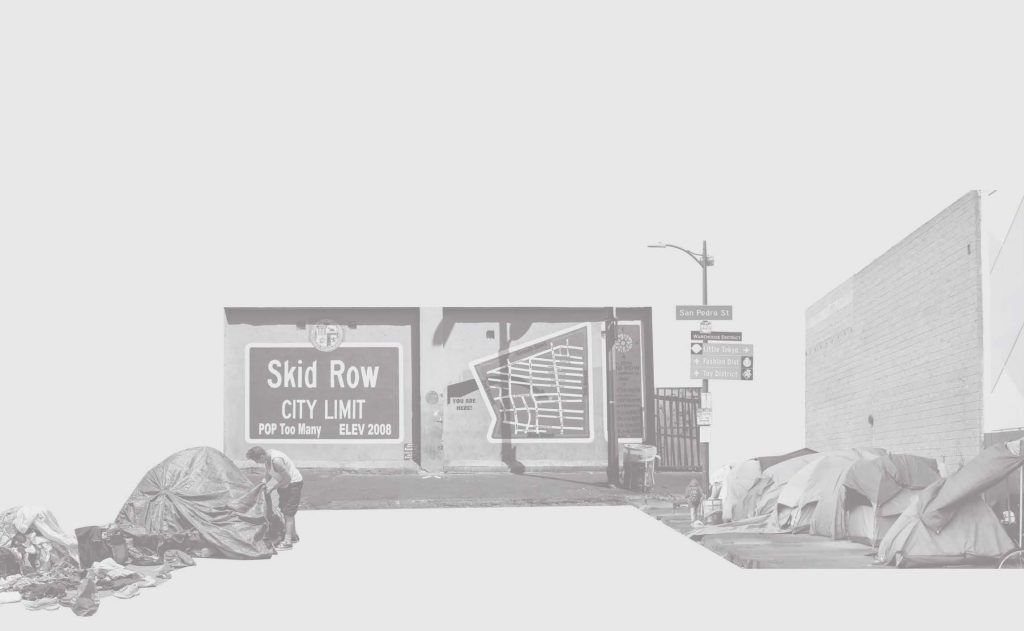
As the sun slowly disappears beyond the horizon, apartment windows in Los Angeles glow with the nighttime rituals of families gathering inside the comfort of familiar walls. Only a few blocks beyond the quiet hum of nighttime lies in the shadows the harsh reality of downtown Los Angeles. At the heart of the city, the people of Skid Row prepare to endure another night out on the unforgiving pavement. Unsure where they will sleep, shuddering in the cold, and exposed to the dangers of the city every hour that passes feels eternal. A fifty-block man-made zone, Skid Row was deliberately designed to contain the homeless population of Los Angeles into one area. An alarming representation of the housing crisis in the US, communities all across the nation have been ravaged by the lack of affordable housing. With a total of 771,480 people, or about .23% of the United States experiencing homelessness in 2024, this issue cannot be ignored. This crisis forces the reexamination of the urban condition in which we exist and the failure of government officials and designers alike to create an equitable city. The future of design and innovation in architecture cannot be the focus of practitioners today when the average public is struggling to find affordable housing. Housing is the city, and the city is housing. How many more people must starve before we change how we approach the city?
Often reduced to the same identity as the pests that live in the warm crevices of the urban playground, the unhoused population is treated as a plague to the city. An inconvenience that must be dealt with rather than the victims of an unjust system. Dispersed throughout the city, they are left with no sense of belonging or community. Since the 1990s major cities in the United States with a strong central business district have “de-concentrate poverty through the inclusion of mixed-income, market-rate and above market-rate (aka, luxury) housing” which has only “served instead to gentrify, displace, and dismantle low-income housing, and move poor and unhoused people to other areas without solving the root problems” (Gudis, p.5). Skid Row, however, presents a different, highly controversial urban planning approach. City planners in the unofficial 1976 “Containment Plan” consolidated resources for the homeless into Skid Row so that “the residents might be inclined to confine their activities to the immediate area,” therefore serving “as a magnet to hold undesirable population elements in Skid Row” (99percentinvisible). Additionally, a buffer zone was created so that “when the Skid Row resident enters the buffer, the psychological comfort of the familiar Skid Row environment will be lost; he will feel foreign” (99percentinvisible). The proposal depicts the homeless population with dehumanizing and alienating language, establishing their otherness and supposed necessary separation from the general population. Outsiders in their own home, Skid Row became the city within the city.
This urban planning approach has successfully prevented the gentrification that has reshaped cities across the nation. However, as a result, it has created a concentrated pocket of poverty, which has become one of the most dangerous and neglected areas of the city. An area the rest of the city avoids has become a dumping ground, with even hospitals reportedly discharging patients with no address to Skid Row. This attempt to protect the residents of Skid Row has become a humanitarian crisis.
Today, faced with a housing crisis, Los Angeles must confront the same question from 1976. How can the city prevent development in Los Angeles from encroaching on and erasing Skid Row? Moves to rezone Los Angeles and develop affordable housing in Skid Row, while appealing, are an idealistic narrative that has been repeated throughout history with little success. Washed away in the sands of time, the hunger for development and the bottom line overtake the dream of social housing projects. To successfully develop Skid Row it is crucial for planners and architects to collaborate with the residents of Skid Row to ensure their collective vision is realized. Failure to provide a voice to those who will be affected by these changes guarantees failure to create effective, affordable housing. Constant communication between the two groups ensures that the urban development will not have a top-down approach that ignores the needs of its residents. Affordable housing as the first step is a move in the right direction. However, if the residents of Skid Row continue to be treated as an inconvenience to be pushed to the side, no real progress will ever be achieved.
The pushback to proposals seeking to help the homeless has already been seen in Los Angeles in response to the HHH proposal, which allocated 1 billion to create more shelters in Los Angeles. A crucial reason for the high rates of homelessness in LA, aside from lack of affordability, is a lack of shelters. The HHH proposal seeks to improve on this; however, little progress has been made due to a “not in my backyard” mentality from Los Angeles residents. This separationist thought process is preventing progress on social projects, as the city’s own residents fail to do their part to help the population in need. It is not enough to speak up if, in a moment of action, a blind eye is turned to the problem. The desensitization to the homelessness crisis as a result of its increasing commonality and the capitalist every man for himself mentality hinders progress towards collective success.
It is the civic responsibility of city planners and citizens to use their roles and power as a way to bridge the gap between these groups, not further their division. By its very nature, city planning is an invasive typology. It seeks to reorganize, design, and control spaces and communities according to a specific vision. It is inherently transgressive. Through city zoning, designing public spaces, and shaping infrastructure, urban planners are the puppeteers of the city. They hold the power to determine and mold countless lives behind the scenes.
Infamous urban planner Robert Moses famously said, “You cannot make an omelet without breaking eggs,” to justify his projects, which displaced communities. Well, perhaps it is time to reimagine a city that does not allow its most vulnerable to fall through the cracks in the name of the future. Perhaps it is time to focus on the present.
- Gudis, Catherine. Containment and Community: Catherine Gudis, PhD Scholar-in-Residence, Los Angeles Poverty Department Associate Professor of History, University of California, Riverside with Skid Row Now & 2040 Coalition October 2022 The History of Skid Row and its Role in. October 2022.
- “HUD Releases 2024 Annual Homeless Assessment Report.” National Low Income Housing Coalition, 13 January 2025.
- “Inside Skid Row, Los Angeles’ Neighborhood For The Homeless.” All That’s Interesting, 13 December 2023.
- 99percentinvisible. The Containment Plan. 99percentinvisible.
