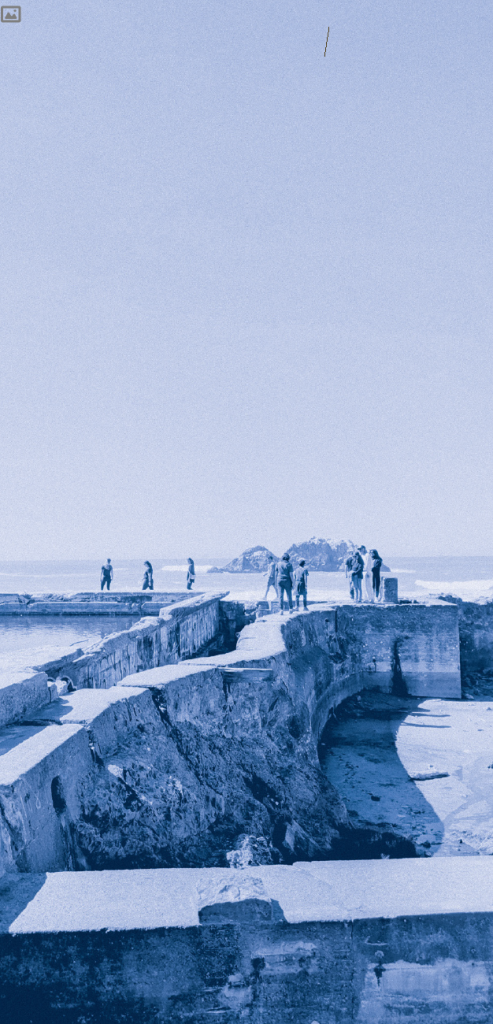
When my studio and I visited San Francisco, we pit stopped on the Pacific Coast, along Highway 1, getting out at the landmark site Sutro Baths. I suppose, in a mirthful sped-up homage to the Classical Romans, the Baths have fallen to ruin, sticking out seaside cliffs with its broken, sandy concrete walls. Since a 1966 fire, the original and historical resort, famous as a homage for Roman-style baths, have been no more.
Standing on raised steps leading to nowhere, the wind blew over the sour smell of the sea, reminding me that air was a thing that exists and may move. Making a list of other fluids nearby—the ocean, miscellaneous gunk, sea foam and waves—I poked around the cracking foundation, finding pools the sea washed up, unusual area slightly overcrowded despite the outdoors, ears annoyed by breeze-related whistling. Albeit, a quiet moment staring down at meditative ripples had me considering a fluid rhythm, timing, and art.
The truth is, the Sutro Baths, like many other great projects, has failed a test of time and was already in talks of demolition before a flame decided all that for it. The Great Depression had beat business to the ground, and the last moments of billionaire philanthropist Adolph Sutro’s grand recreational project, celebration of art and technology and life, was reduced to a dismal skating rink, generating nowhere near profitable for the site. Time has not been most kind to these baths, but time has also allowed a particular transition since the fire.
The Sutro Baths (or what’s left of them) currently interact with fluid-ness differently than the typical architect-decisive-design intent. Adolph Sutro had built grand skylights, boutique shops, and swimming pools, quite the bougie resort— yet, reveling in their place now, are open water wells and sand covered walls, an inverted and absurd version of nature and a house. Divided by paths of chipped ledges and rebar, the surviving foundation has formed ledges allowing rain and seawater to pool. Without a roof or covering, the Sutro Baths now accept (or fail to avoid) wildlife and teenage stragglers, painted in bird droppings and drunk-minded littering, over old bones of prestige and wealth. Resembling a crumbled maze, grand rooms once boasting frigidarium‘s, tepidarium‘s, caldarium‘s; now rely on a plain, not even whole, burnt foundation for implied drops of space and circulation. Instead of leisurely food stands and pool-bathing, groundwater trickling down a fat rusty pipe, funds the growing algae regime, feeding a quacking mallard duck family, entertaining the local dogs, joggers, and general observers. Waves wash and spill, up and over concrete blocks, creating the only consistent program here of erosion, doing the non-repairing work of carving stones. Coastal wind determines bird groups flying in or out, along with the people in cars arriving with cleared skies or leaving when the sky starts to rain. Perhaps the rain was also what finally mercifully stopped the flames, but for now, the weather continues to hasten the project’s destruction and ruin into a land’s use and adjustment.
Currents of wind, water, and people mingle about, rubbing more pieces of chippy walls and glass away from the structure, but the sea smoothed the content out, dropping new sea glass and tile into the sandy terrain of which nearby I spotted more ocean, gulls, and human carved names. Eventually as left to these fleeting devices, marking not-so fleeting structures, the natural order and direction of physical things will erode walkable paths below the flood line, and the Sutro Bath’s current inhabitants and program will reshuffle and reorganize again. Standing around remains from that day and getting pushed by wind one way simply rocked order and time back another way.
