A Powerful Wall Against Autocracy
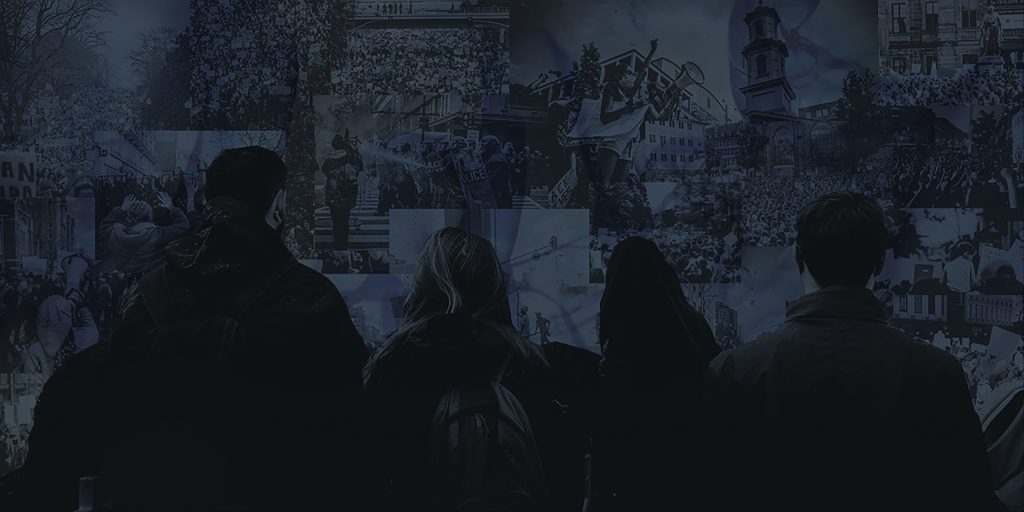
The United States of America has a long history of protests, and therefore a long history of local protest architecture. In his book Protest Architecture, Nick Newman lists several intentions and actions something must have to qualify as “protest architecture” which can be summarized as “…relating to the use of physical structures to facilitate protest.” The most common forms of protest architecture in the US are occupation.
Occupation is defined as the protester’s occupation of space in order to garner attention or slow “business as usual.” This tactic was often employed during the Civil Rights Movement. During the 1950s and 60s, protests fighting discrimination and segregation of non-white people broke out across the country, spawning some of the most well-known American activists. Their use of occupation manifested through the many sit-ins, marches, and demonstrations across the country, which were often held at governmental buildings or political monuments for their symbolic representation of America.
Another common form of protest is alteration. This is defined as making changes to symbolic pieces of the built environment, like statues or artifacts, to garner
greater attention for a specific cause. This was seen in the Black Lives Matter protests of the early 2020s, where many protesters vandalized or even removed statues of celebrated racists and slave owners across the country to protest their idolization in American history.
Most recently, the current president, Donald Trump, has sparked a new wave of protests across the country against his overreach of presidential power and policies increasing detainments and deportations through ICE. These have been called No Kings protests and anti-ICE protests respectively. These movements begin a new chapter in the history of protest in America as anti-autocratic protests had been widely reserved for other nations. Until now, the USA has not had to deal with potential dictators or autocrats within its own borders since the American Revolution.
So far, many of the No Kings protests have taken the form of marches or walk outs, both forms of occupation. However, protesters’ cries have fallen on deaf ears, instead being met with increased police presence and violence. As these protests continue to be met with hostility, the question of the efficacy of occupational protest in this context emerges, and with that the question of what form of protest may replace it.
Barricades as protest architecture seek to block movement through streets or public pathways using a temporary wall. They also serve a secondary purpose, providing shelter for protesters against crowd-dispersing measures like tear gas or rubber bullets. There is no singular look to barrier architecture as they are typically made out of whatever material protesters are able to move in the surrounding area, ranging from timber to street furniture and they are often hastily put together and not intended to be permanent structures.
Barricades as a form of protest architecture do not have a prominent history in the US, but are often linked to anti-autocratic protests. The most famous use of barricades is during the French Revolution where revolutionaries would use them as protection from armed forces. Another example is in Sudan. There, barricades have a history of being used to fight against military rule, and were prominently featured in 2019 in opposition to the attempted coup.
While the No Kings and anti-ICE protests seem to be protesting two separate issues, they are both linked back to the same source: government overreach enacted by current president Donald Trump. Though only one movement directly references the idea, they
are both anti-autocratic protests, and as a prominent form of anti-autocratic protest architecture, barricades have begun to appear.
Recently, in attempts to block ICE from detaining people, groups have begun gathering outside places like parking garages where ICE keeps their vehicles, intentionally blocking the exit to prevent them from getting on the streets. While this bears some resemblance to occupation by using the human body to disrupt ICE agents, it also functions similarly to the barricade as it has the quintessential quality of physically blocking access to roads.
America is facing something it has never seen before, a threat to the very democracy it was founded upon. As such, the people must adapt. Strategies used and encouraged in the past aren’t as effective against a leader who doesn’t care about the voice of the people. Government action has only grown more violent, and the people have found a way to protect themselves. Barrier architecture has a long history in anti-autocratic movements, both stopping the advancement of military force and protecting citizens against harm, and as it starts to appear in more protests, it may become a prominent form of protest in the people’s fight against this administration.
