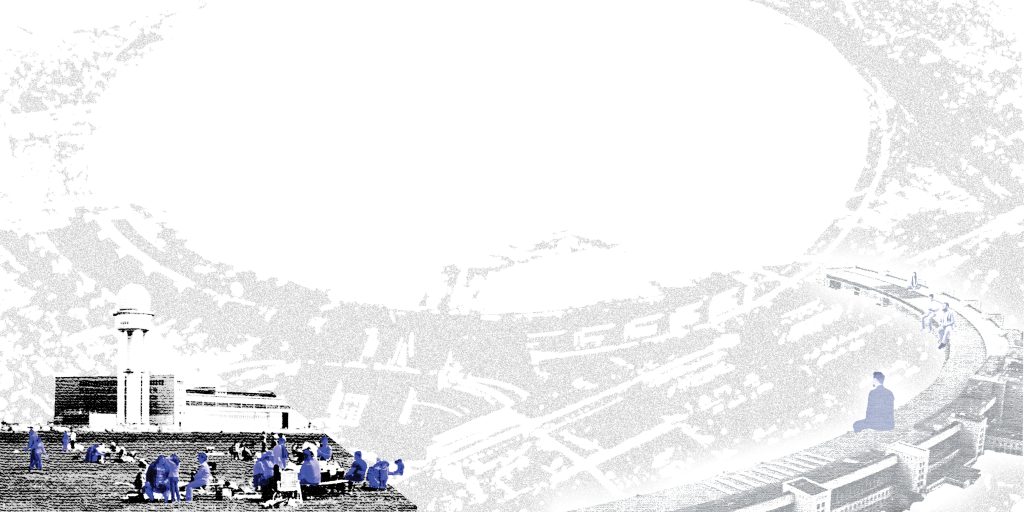
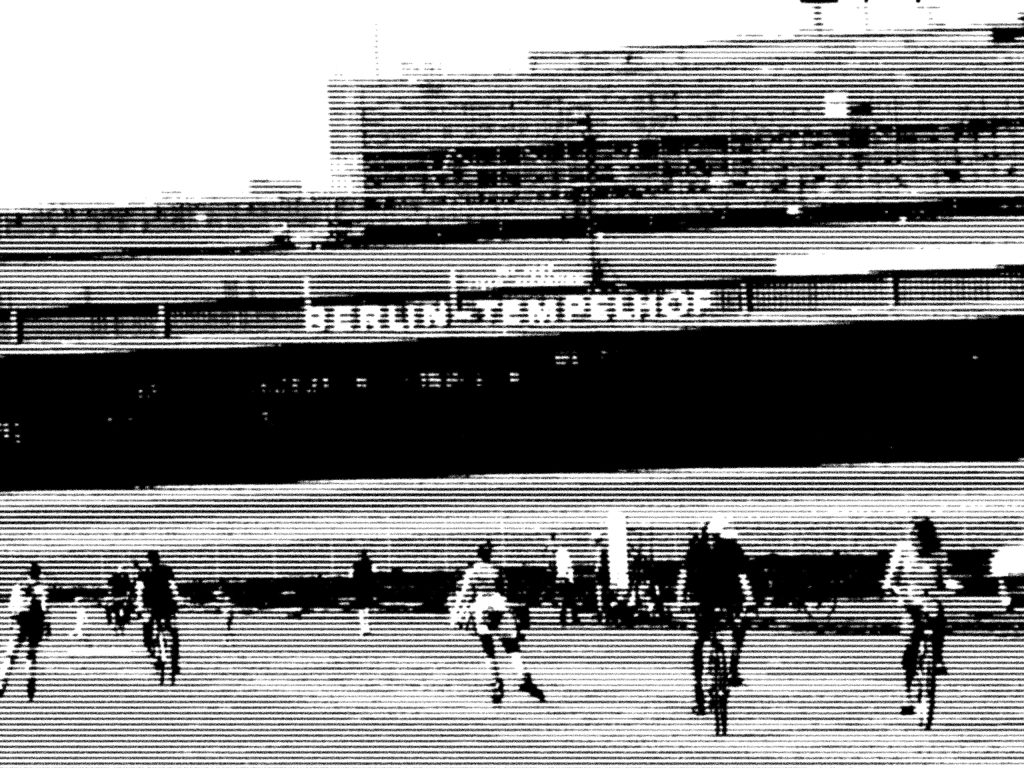
If you look through the city fabric of Berlin, roughly 1000 acres of infinite open land is placed in the center. It acts as a rupture to the density that surrounds it. Tempelhof Airport, instead of being occupied by aircrafts, is filled with different activity on the tarmac. Basketball courts, soccer fields, sunbathing, and bike riding all fill one of Germany’s decommissioned airports. Now, it stands redefined by the people who claim the space.
Rather than an afterthought or a failure to predict, designers can treat retroactivity as an intentional strategy. The unprompted, unforeseen behavior within a space that is determined by the agency of the users unveils a desire to shape form. While these desires may not have fully formulated spaces that have been planned, inspected, or consulted, they are through more delicate, interpersonal relationships. Instead of a space designed for the prediction or control of behavior, it is the initiative of those inhabiting the space that reveals the part of human behavior that cannot be designed for. As designers, aggrandize examples of control and totalitarianism are presented as the archetype of behavioral jurisdiction. Instead, it is in contemporary examples of technology and infrastructure that implement subtle and unseen authority over public behavior.
Before the community gardens, mini-golf courses, and skateparks, what occupied Tempelhof Airport was much different. When the Airport was first constructed in World War II, it was the largest building in Europe during that time. The assertiveness and scale of the design exemplified the Nazi regime which utilized the airport to expand Adolf Hitler’s planned Aryan Utopia. After World War II, the airport was decommissioned due to its inadequately sized runways for commercial use. What was once a symbol of fascism and totalitarianism became a symbol of liberation as the public began to reinvent the many acres of open space.
Architectural design attempts to evoke, provide, and produce, but it also at times, attempts to predict. These modes of prediction, specifically towards human behavior, have historically been used to create the most efficient and economical forms of design. This was most prevalent in the social housing projects of the early modern era. In “Seeking Like a State” by James C. Scott, Scott dissects The Radiant City by Le Corbusier. Here, Scott explains how the proposed design for utopian cities attempted to categorize key human behaviors and dimensions in order to achieve a machine-like quality. Le Corbusier assumed that human behavior always followed predictable functions. The strategy employed in this design is segregation of function. Urban zones would only be designed for one purpose with no intermingling between work, home, and public spheres. The careful shaving away of excess which leaves the architectural space down to its exo-skeleton is, however, negligent to the unpredictability of human behavior.
Abandoned and scarred by the history of the past, the people of Berlin reinvented the Tempelhof airport not through reconstruction, but reorganization of the communities that could be built there.
As designers we have made the mistake of thinking that megalithic examples such as the radiant city are the only examples in which architecture controls behavior. A new push for contemporary user-centered design, in a guise to bring control back to the user, has instead done the opposite. In an attempt to make every aspect of design digestible, meaning has been abstracted and reduced. The objects we interact with everyday, whether that be technology or elements of infrastructure, can be considered as black boxes. The Black Box is a system that abstracts its inner workings from the users of that object. The only visible process is the input and output of its function. This is seen in a vast array of technology applications, particularly phones and computers. The code that runs its processes are invisible, the inner workings abstracted. The users are therefore dependent on a technology that is not fully understood besides the outputs. Unlike domineering master plans such as the radiant city, technology and infrastructure allude to more subtle forms of power and control. For example, the Graphical User Interface, popularized by Macintosh, emphasizes clarity and function when interacting with the company’s technology.
The fluid state that the Tempelhof Airport resulted in and its ability to transform its use based on the influence of its inhabitants reveals one of the unplanned aspects of architectural design.
Architecture has become a black box in it of itself. The large infrastructural and technological networks that run through it contain unknown inner workings to the public. When introduced to a space where one has little knowledge over the complexity of operations inside, there becomes less agency over the space due to its abstracted interface. Data collection embedded in urban environments such as wifi, bluetooth quietly accumulates information. Bernard Tschumi explores in Architecture and Disjuncture architecture as a montage, where movement throughout a space produces its meaning. This relationship creates a juxtaposition between abstract concepts and immediate experiences. Tschumi claims that traditional modes of architecture design around the idea of bodies moving within the space, rather than the actual movement itself. Tschumi also claims that the solution to this restrictiveness is to create spaces where the program is not strictly enforced, utilize cross-programming, and to treat spaces as a framework, not a script.
The master redesigning of Medellin Colombia, a city consumed by violence in the 1980s and 1990s, undermined extreme community research in its redesign. Instead of attempting to choreograph space to solve specific problems, the city focused on mobility, education, and governance. The city underwent a consultative strategy, by identifying communities with the highest needs and addressing them. While Medellin is an example of a city whose government took control to ensure equitable access, self-founded spaces emerge in a more spontaneous form. For example, the Kowloon Wall City in Hong Kong was a lawless enclave that had a population density of 3.2 million people per
mile in the 1980s. The solid mass of the building was filled with tiny building modules of residents. Originally a military fort, once the space was annexed, inhabitants moved into the space and self-constructed forms to create the hyper-dense city. Its internal arrangement was invisible, however, it was deeply known by its inhabitants. Both cities are examples of how black-box infrastructure becomes dismantled, and the inhabitants of that space take control. While Medellin Colombia underwent a consultative strategy that was controlled by the government, the extent of gathering information from the public resulted in spaces that were deeply reflective of their needs. The Kowloon city flips the concept of the black box on its head, with its inner workings only known to the public instead of those in power.
User behavior and agency over a space is a fluid construct. It is unpredictable. While looking at historic examples where there are attempts to control behavior and predict it, large urbanities tend to be cited. However, in contemporary infrastructure, these themes of control are decimated in a more subtle way. The Kowloon Wall city and Medellin Colombia both embody user agency over a space. The case of Tempelhof Airport operates between these conditions. It reveals how space can be reinterpreted when left to public discretion. The challenge for architecture is not to eliminate infrastructure or technology, but to resist their total abstraction.
By designing frameworks rather than scripts, architecture can return a degree of agency to its users while acknowledging that behavior cannot be fully predicted.
Through Templehof, land is given back to Berliners. The treeless expanse extends outward towards the horizon, creating an endless space of activity. The activities that occur there now represent the public interests of the people who use it. This
is a display of behavior within a space that is unrestricted and self-constituted.
